GAME GUIDE
FreeCell
Use four free cells to organize the tableau.
01 · UNDERSTAND THE PRINCIPLE
Essential rules
Objective
Move all cards to the foundations using the free cells as temporary storage.
Variant played: Four cells · grouped moves limited by free spaces
- Players
- 1
- Duration
- 5–20 min
- Deck
- 52 cards
Setup
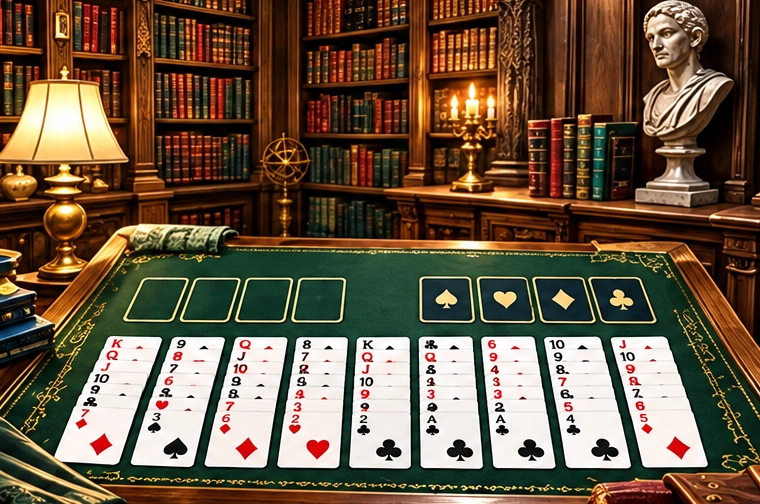
- Deal all 52 cards face up into 8 columns: four columns of 7 cards and four of 6.
- Four free cells and four foundations start empty.
- No draw or redeal.
Turn or round flow
- Move a card to a free cell, a foundation, or another column.
- Move an alternating descending sequence if the number of cards can be carried with the available free spaces.
- An empty column accepts any movable card or sequence.
Detailed rules
Detailed rules
Variant played: Four cells · grouped moves limited by free spaces · Version 1.0.0
Objective
Move all cards to the foundations using the free cells as temporary storage.
Setup
- Deal all 52 cards face up into 8 columns: four columns of 7 cards and four of 6.
- Four free cells and four foundations start empty.
- No draw or redeal.
Turn or round flow
- Move a card to a free cell, a foundation, or another column.
- Move an alternating descending sequence if the number of cards can be carried with the available free spaces.
- An empty column accepts any movable card or sequence.
Legal actions and obligations
- Tableau: descending rank, alternating colors.
- Foundations: same suit, Ace to King.
- Each cell holds one card maximum.
- Supermove capacity: (free cells + 1) × 2^(usable empty columns), subtracting the destination column if it is empty.
Score
- Win when all 52 cards are on the foundations.
- Optional score based on time and number of moves, with no currency.
End of game
- The game ends with a win or a forfeit; a detector can announce that no useful move remains without blocking the player.
Locked special cases and variants
- Auto-foundation is used only if it does not make a needed card inaccessible under a safety rule.
- Deal number kept to reproduce a game exactly.
Artificial intelligence
The AI uses only its hand, public cards, the allowed history, and the legal actions sent by the server.
Easy
Chooses only among legal actions, with some randomness and no deep lookahead.
Normal
Uses a stable heuristic strategy, taking into account the score, the turn, and the visible cards.
Hard
Evaluates multiple action sequences, remembers public information, and limits tactical mistakes.
- Hint AI frees Aces and low cards, avoids filling every cell, and creates empty columns.
- Hard uses transposition search and recognizes equivalent moves.
02 · Cards to inspect
Cards to inspect
Look at the ranks and suits of these cards.
VIDEO ACTIONSView every type of move
Play down in alternating colors
1 / 6Preparing cards…
Read the steps in this demo
- Spot the leading card in the move.
- Move the 8♥, 7♣, 6♦ run under the 9♠.
- The column remains descending and alternates red and black.
Cards to inspect
01 · Situation
Spot the leading card in the move.
Play a card one rank lower and of the opposite color. A red 8 goes on a black 9; a black 8 is not valid.
Teaching example · playable table cards