GAME GUIDE
Gin rummy
Build melds and reduce deadwood.
01 · UNDERSTAND THE PRINCIPLE
Essential rules
Objective
Build melds and reduce the value of unmatched cards, called deadwood.
Variant played: Two players · knock instead of draw in this variant · limit 10
- Players
- 2
- Duration
- 10–25 min
- Deck
- 52 cards
Setup
- 2 players, 10 cards each; one face-up card starts the discard pile.
- Combination: a group of 3 or 4 cards of the same rank, or a run of at least 3 consecutive cards of the same suit.
- Low aces only; Q-K-A is not allowed.
- Deadwood value: Ace 1, 2-10 face value, face cards 10.
Turn or round flow
- On your turn, draw the top card from the stock or discard pile.
- Then discard one card; you cannot take back the discard and immediately reject that same card.
- After discarding, the player may knock if their deadwood is 10 or less, or declare gin at 0.
Detailed rules
Detailed rules
Variant played: Two players · knock instead of draw in this variant · limit 10 · Version 1.0.0
Objective
Build melds and reduce the value of unmatched cards, called deadwood.
Setup
- 2 players, 10 cards each; one face-up card starts the discard pile.
- Combination: a group of 3 or 4 cards of the same rank, or a run of at least 3 consecutive cards of the same suit.
- Low aces only; Q-K-A is not allowed.
- Deadwood value: Ace 1, 2-10 face value, face cards 10.
Turn or round flow
- On your turn, draw the top card from the stock or discard pile.
- Then discard one card; you cannot take back the discard and immediately reject that same card.
- After discarding, the player may knock if their deadwood is 10 or less, or declare gin at 0.
Legal actions and obligations
- A card can belong to only one combination in the optimal calculation.
- After a non-gin knock, the opponent may lay their deadwood cards onto the knocker's melds.
- No layoff is allowed against a gin.
Score
- Knock successful: difference between opponent deadwood after layoff and knocker deadwood.
- Undercut: if the opponent has deadwood less than or equal to yours, they score the difference +25.
- Gin: 25 + the opponent's total deadwood points.
- A dead hand after the stock is exhausted scores no points.
End of game
- The round ends by knock/gin or when the stock has only two cards left without a knock.
- The game ends when a player reaches 100 points; configurable game bonuses are off by default.
Locked special cases and variants
- On the first turn, the non-dealer may take the upcard or pass; the dealer then has the same option; if both pass, the non-dealer draws from the stock.
- Big Gin and Oklahoma Gin are disabled.
Artificial intelligence
The AI uses only its hand, public cards, the allowed history, and the legal actions sent by the server.
Easy
Chooses only among legal actions, with some randomness and no deep lookahead.
Normal
Uses a stable heuristic strategy, taking into account the score, the turn, and the visible cards.
Hard
Evaluates multiple action sequences, remembers public information, and limits tactical mistakes.
- Easy keeps completed melds and discards the highest deadwood.
- Normal calculates the best meld layout and avoids discarding cards that help the opponent, based on visible history.
- Hard estimates the opponent's likely cards, compares an immediate knock with going for gin.
02 · Cards to inspect
Cards to inspect
Look at the ranks and suits of these cards.
VIDEO ACTIONSView every type of move
Choose your draw
1 / 8Preparing cards…
Read the steps in this demo
- The reserve is available.
- Flip the dealt cards.
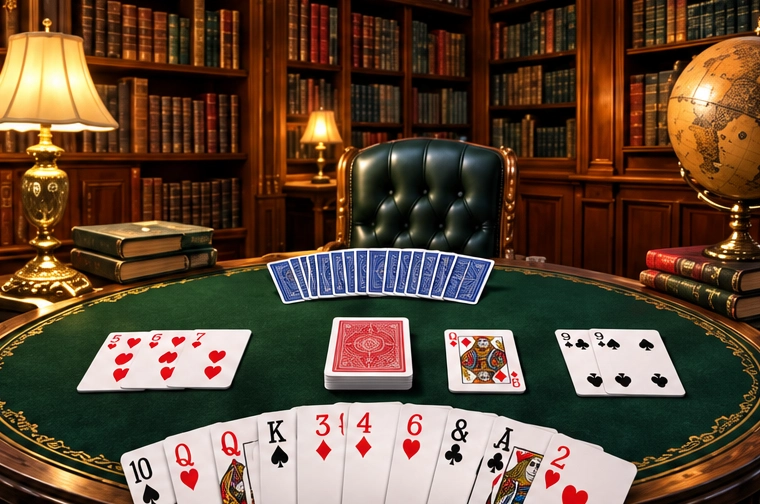
- The 9♥ can complete your hidden 7♥–8♥ sequence.
Cards to inspect
01 · Situation
The reserve is available.
At the start of the normal turn, choose the stock or the top of the discard pile, then discard a card. Melds stay in your hand during play.
Teaching example · playable table cards