GAME GUIDE
Omaha
Four hole cards, five community cards; exactly two hole cards must be used in the final hand.
01 · UNDERSTAND THE PRINCIPLE
Essential rules
Objective
Four hole cards, five community cards; exactly two hole cards must be used in the final hand.
Variant played: CardVerse variant · no-limit bets · exactly 2 private cards + 3 community cards
- Players
- 2 to 9
- Duration
- 15–45 min
- Deck
- 52 cards
The four private cards
Omaha deals four private cards to each player. They remain hidden from opponents until showdown.
Check or call
With no bet to match, you may check. Against a bet, calling only pays the difference: if you have already committed 10 and the bet reaches 30, add 20 fictional chips.
Bet and raise
A raise increases the amount to call. Respect the suggested minimum and your fictional chip stack; a small bet does not always reopen raising after an all-in.
Fold
Folding abandons this hand. Chips already committed stay in the pot; your private cards are not shown to the other players.
Stacks and pots kept separate
An all-in player can win only the pots they contributed to. Example: A commits 30, B and C commit 60 each. The main pot contains 90 and the side pot 60, contested by B and C only.
Exactly two plus three
The final hand uses exactly two hole cards and three community cards. Example: A♠ and R♠ as hole cards, with D♠, V♠, and 10♠ as community cards, make a straight flush. The other two hole cards do not count.
A single private card is not enough
Four spades on the table and only one spade in your private hand are not enough to make a flush: you must always keep two private cards.
The community board
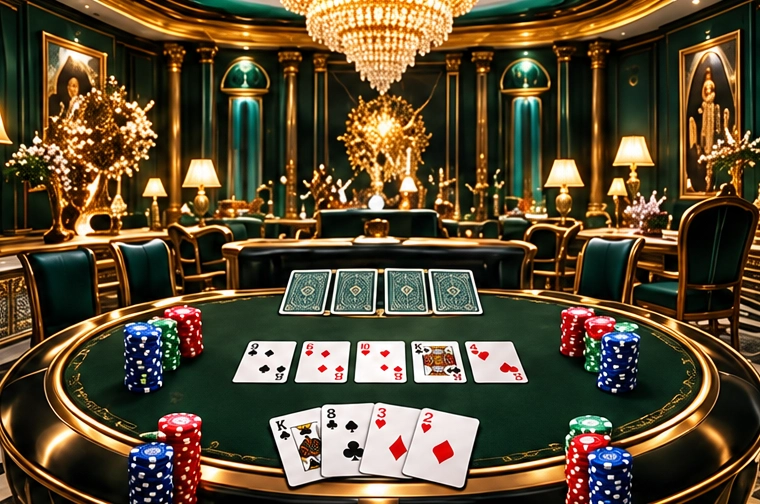
The flop brings three community cards, the turn a fourth, and the river a fifth. These cards are shared; they do not replace your four private cards.
High card
Without a pair, straight, or flush, compare the highest card, then the next if needed. Suits do not break ties between two hands.
Pair
Two cards of the same rank make a pair. The higher pair wins; if pairs are equal, the other three cards break the tie in descending order.
Two pair
Two different pairs beat one pair. Compare the higher pair, then the lower pair, then the fifth card.
Three of a kind
Three cards of the same rank make three of a kind. It beats two pair; with equal three of a kind, compare the other two cards.
Straight
Five consecutive ranks make a straight. Suits may differ. The Ace can complete 10–V–D–R–A or start A–2–3–4–5; it does not wrap around in the middle.
Flush
Five cards of the same suit make a flush. They do not need to be consecutive. Two flushes are compared by rank, not by suit.
Full house
A three of a kind and a pair make a full house. Compare the three of a kind first, then the pair. A full house beats a flush.
Four of a kind
Four cards of the same rank make four of a kind. It beats a full house; with equal four of a kind, the fifth card breaks the tie.
Straight flush
A five-card sequence of the same suit is a straight flush. Compare its highest rank. It beats all previous hand types.
Royal flush
10, Jack, Queen, King, and Ace in the same suit make the highest straight flush. It is often called a royal flush.
Detailed rules
Variant played: CardVerse variant · no-limit bets · exactly 2 private cards + 3 community cards · Version 1.0.0
The essentials to get started
Four hole cards, five community cards; exactly two hole cards must be used in the final hand.
The four private cards
Omaha deals four private cards to each player. They remain hidden from opponents until showdown.
Check or call
With no bet to match, you may check. Against a bet, calling only pays the difference: if you have already committed 10 and the bet reaches 30, add 20 fictional chips.
Bet and raise
A raise increases the amount to call. Respect the suggested minimum and your fictional chip stack; a small bet does not always reopen raising after an all-in.
Fold
Folding abandons this hand. Chips already committed stay in the pot; your private cards are not shown to the other players.
Stacks and pots kept separate
An all-in player can win only the pots they contributed to. Example: A commits 30, B and C commit 60 each. The main pot contains 90 and the side pot 60, contested by B and C only.
Exactly two plus three
The final hand uses exactly two hole cards and three community cards. Example: A♠ and R♠ as hole cards, with D♠, V♠, and 10♠ as community cards, make a straight flush. The other two hole cards do not count.
A single private card is not enough
Four spades on the table and only one spade in your private hand are not enough to make a flush: you must always keep two private cards.
The community board
The flop brings three community cards, the turn a fourth, and the river a fifth. These cards are shared; they do not replace your four private cards.
High card
Without a pair, straight, or flush, compare the highest card, then the next if needed. Suits do not break ties between two hands.
Pair
Two cards of the same rank make a pair. The higher pair wins; if pairs are equal, the other three cards break the tie in descending order.
Two pair
Two different pairs beat one pair. Compare the higher pair, then the lower pair, then the fifth card.
Three of a kind
Three cards of the same rank make three of a kind. It beats two pair; with equal three of a kind, compare the other two cards.
Straight
Five consecutive ranks make a straight. Suits may differ. The Ace can complete 10–V–D–R–A or start A–2–3–4–5; it does not wrap around in the middle.
Flush
Five cards of the same suit make a flush. They do not need to be consecutive. Two flushes are compared by rank, not by suit.
Full house
A three of a kind and a pair make a full house. Compare the three of a kind first, then the pair. A full house beats a flush.
Four of a kind
Four cards of the same rank make four of a kind. It beats a full house; with equal four of a kind, the fifth card breaks the tie.
Straight flush
A five-card sequence of the same suit is a straight flush. Compare its highest rank. It beats all previous hand types.
Royal flush
10, Jack, Queen, King, and Ace in the same suit make the highest straight flush. It is often called a royal flush.
The table guides you through each turn and suggests the legal moves. This guide presents the basic rules; regional variants may differ.
02 · Cards to inspect
Cards to inspect
Look at the ranks and suits of these cards.
VIDEO ACTIONSView every type of move
The four private cards
1 / 18Preparing cards…
Read the steps in this demo
- The reserve is available.
- Flip the dealt cards.
- Four private cards, but only two will be kept.
Cards to inspect
01 · Situation
The reserve is available.
Omaha deals four private cards to each player. They remain hidden from opponents until showdown.
Teaching example · playable table cards