GAME GUIDE
Spider
Build complete same-suit sequences.
01 · UNDERSTAND THE PRINCIPLE
Essential rules
Objective
Build and clear eight complete King-to-Ace suit stacks.
Variant played: Two suits by default · one- or four-suit options
- Players
- 1
- Duration
- 10–30 min
- Deck
- 104 cards
Setup
- Use 104 cards.
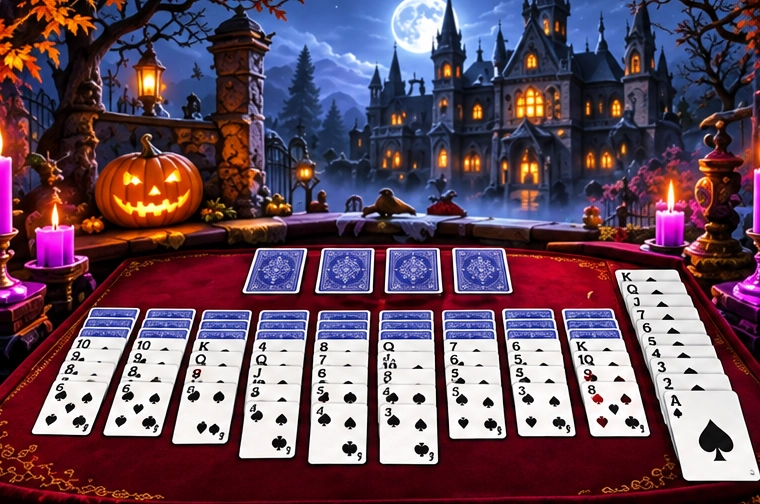
- Deal 54 cards into 10 columns: 6 cards in the first four and 5 in the other six; only the top card is visible.
- The 50 remaining cards make 5 deals of 10 cards.
Turn or round flow
- Move a face-up card or sequence of the same suit in strict descending order.
- A card/sequence may be placed on a card of the immediately higher rank, whatever its suit.
- An empty column accepts any legal card or sequence.
- Deal a new row of 10 cards when needed.
Detailed rules
Detailed rules
Variant played: Two suits by default · one- or four-suit options · Version 1.0.0
Objective
Build and clear eight complete King-to-Ace suit stacks.
Setup
- Use 104 cards.
- Deal 54 cards into 10 columns: 6 cards in the first four and 5 in the other six; only the top card is visible.
- The 50 remaining cards make 5 deals of 10 cards.
Turn or round flow
- Move a face-up card or sequence of the same suit in strict descending order.
- A card/sequence may be placed on a card of the immediately higher rank, whatever its suit.
- An empty column accepts any legal card or sequence.
- Deal a new row of 10 cards when needed.
Legal actions and obligations
- A new row cannot be dealt if a column is empty.
- Only same-suit sequences can be moved as a group.
- When a complete King-to-Ace run of the same suit appears, it is removed automatically.
Score
- Win: 8 sequences removed.
- Optional score: start at 500, -1 per move, +100 per completed sequence.
End of game
- The game ends with a win or a forfeit; no automatic loss is declared as long as a move or deal is still possible.
Locked special cases and variants
- Levels 1, 2, and 4 suits use the same movement rules.
- Undo is allowed in Relax mode; deals cannot be undone, depending on competitive settings.
Artificial intelligence
The AI uses only its hand, public cards, the allowed history, and the legal actions sent by the server.
Easy
Chooses only among legal actions, with some randomness and no deep lookahead.
Normal
Uses a stable heuristic strategy, taking into account the score, the turn, and the visible cards.
Hard
Evaluates multiple action sequences, remembers public information, and limits tactical mistakes.
- Hint AI prefers to build/extend a same-suit run, reveal a hidden card, and preserve empty columns.
- Hard searches move sequences while accounting for temporary column capacity.
02 · Cards to inspect
Cards to inspect
Look at the ranks and suits of these cards.
VIDEO ACTIONSView every type of move
Build by rank
1 / 5Preparing cards…
Read the steps in this demo
- Spot the leading card in the move.
- Play the 8♠ under the 9♥.
- Ranks descend, but the suits differ.
Cards to inspect
01 · Situation
Spot the leading card in the move.
A card may be placed on an immediately higher rank, even from another suit. This move does not necessarily create a sequence that can be moved as a group.
Teaching example · playable table cards